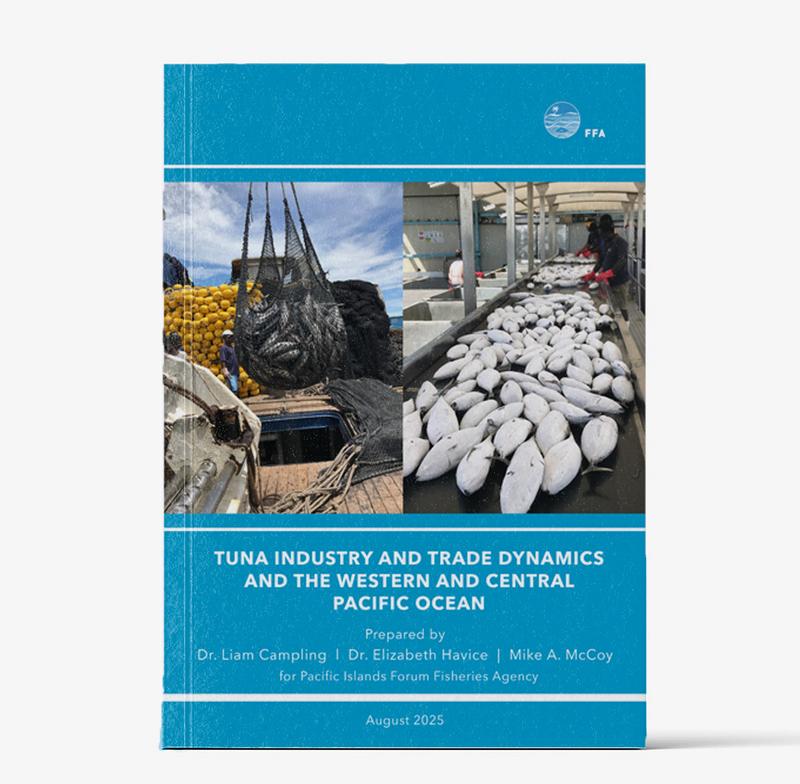
The Pacific Islands Forum Fisheries Agency (FFA) has released a new report examining global tuna markets and trade trends in the Western and Central Pacific Ocean (WCPO), highlighting major shifts in the international tuna industry and their implications for Pacific Island countries and territories.
Titled Tuna Markets and Trade Dynamics: Western and Central Pacific Ocean, the report finds that global tuna markets are undergoing significant change, driven by shifting consumer demand, supply chain disruptions, inflation, geopolitical uncertainty and increasing sustainability requirements.
Funded by the Japan Promotion Fund, the report provides up-to-date market and industry analysis to help FFA members better understand current conditions and emerging trends in the global tuna sector. It underscores the Pacific region’s importance as the source of more than half of the world’s tuna supply, while noting that much of the processing, trading and retail activity continues to take place outside the region, limiting value capture by coastal states.
Covering the period from 2022 to 2025, the report analyses global tuna industry and trade dynamics from the perspective of Pacific Island countries, which supply more than half of the world’s tuna and play a leading role in sustainable fisheries management. It finds that global tuna markets are becoming increasingly competitive and volatile, shaped by shifting consumer demand, rising sustainability and traceability expectations, and external pressures such as climate impacts, fuel and logistics costs, and geopolitical uncertainty.
While large multinational firms continue to dominate processing, branding and retail markets, Pacific Island countries remain the cornerstone of the global tuna industry through their stewardship of WCPO tuna resources and regional management frameworks such as the Vessel Day Scheme.
The report also examines recent industry and trade developments in the WCPO tuna fishery, including the role of major global firms, emerging Asian players, Pacific-led initiatives, and evolving environmental, social and governance (ESG) and trade trends. It notes that Chinese and Philippine companies continue to expand their influence across fishing, processing and trading through vertical integration and strategic investment.
The analysis highlights that Pacific Island countries hold their greatest leverage at the point of resource ownership and access, where regional cooperation has successfully secured value from the fishery with relatively low risk. It cautions that expanding into harvesting and onshore processing can expose countries to high commercial and financial risks in a highly competitive global value chain, particularly where scale, market access and branding power are limited.
Instead, the report points to Pacific-led pathways that build on existing strengths, including sustainability leadership, traceability and strategic market engagement, as more effective approaches to increasing economic returns, strengthening bargaining power and supporting long-term development outcomes for Pacific peoples.
FFA Director-General Noan David Pakop said the report underscores the importance of evidence-based decision-making.
“These insights help our members understand how global developments are shaping the Pacific tuna industry,” Pakop said. “They support better planning to manage risks, identify opportunities and secure long-term economic benefits from sustainably managed tuna resources.”
The report provides valuable context for policymakers, fisheries managers and industry stakeholders as the region responds to a rapidly changing global seafood market while safeguarding tuna stock sustainability. It builds on earlier FFA market studies and supports regional initiatives such as the East New Britain Initiative.
The publication forms part of FFA’s ongoing work to provide members with timely market intelligence and practical analysis to strengthen the region’s collective position in global tuna trade.
Get full report here.